
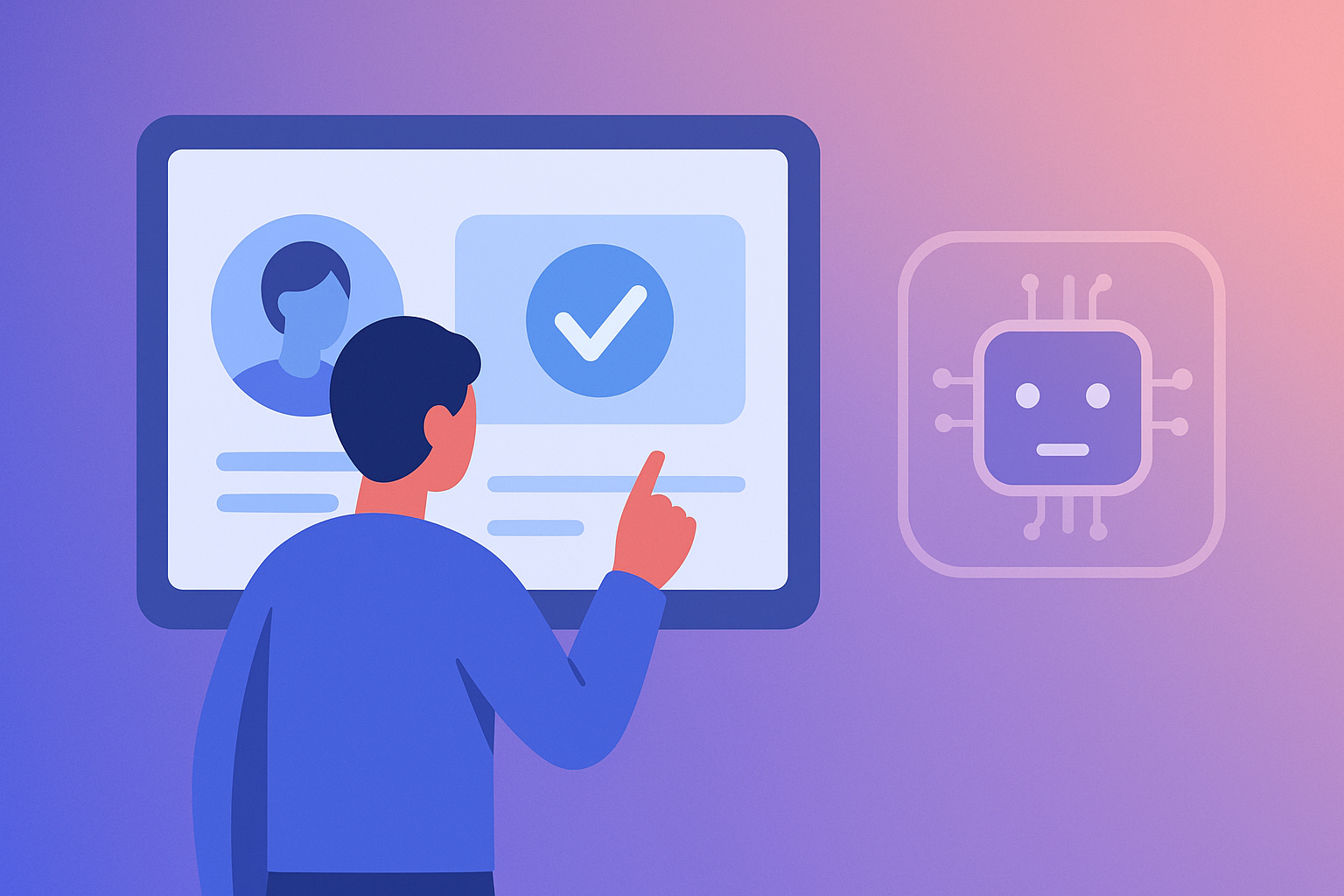
AI impersonation is no longer a distant threat; it is already reshaping how trust operates online. From realistic deepfakes to synthetic identities and voice cloning, distinguishing between real and artificial has become increasingly difficult.
In this environment, simply claiming to be real is no longer enough.
A new standard is emerging — one that focuses not on profiles or credentials, but on verifiable proof that a real human was present.
This is where the concept of “Verified Human” must be redefined.
The Rise of AI Impersonation
AI impersonation has advanced rapidly in recent years.
Modern tools can now:
- Generate highly realistic human faces
- Clone voices with minimal input
- Create convincing video deepfakes
- Simulate human behaviour at scale
These capabilities are no longer restricted to advanced labs. They are widely accessible and increasingly easy to use.
This creates a serious problem.
Synthetic identities can now appear legitimate across multiple platforms, making them difficult to detect using traditional methods.
These identities are being used for:
- Fraud and financial scams
- Social engineering attacks
- Impersonation of public figures
- Manipulation of online communities
As a result, trust in digital interactions is weakening.
Why Traditional “Verification” Is No Longer Enough
Historically, verification has relied on:
- Email confirmation
- Passwords and logins
- Platform-issued badges
- Document uploads
These methods are no longer reliable indicators of authenticity.
They can be:
- Faked
- Stolen
- Reused
- Automated
Even biometric systems that store data introduce new risks, particularly if that data is compromised.
In the age of AI, verification must evolve.
It must answer a much simpler but more important question:
Was a real human present?
What “Verified Human” Actually Means
Verified human status should not be confused with identity ownership or reputation.
A true verified human signal confirms one thing clearly:
A real human successfully completed a biometric verification event at a specific point in time.
This means:
- A live human was physically present
- The verification process could not be spoofed
- The result is anchored to a specific moment
It does not mean:
- The person is trustworthy
- The identity is permanently confirmed
- The behaviour is guaranteed
This distinction is critical.
Verified human status is about proof of presence, not proof of character.
The Problem with Stored Identity Systems
Many traditional identity systems rely on storing data:
- Facial images
- Biometric templates
- Identity documents
This creates long-term risk.
If this data is breached, it cannot be changed or reset like a password.
It also creates:
- Centralised targets for attackers
- Ongoing privacy concerns
- Increased regulatory burden
In a world of AI-driven impersonation, storing identity data is becoming increasingly problematic.
A New Model: Proof Instead of Storage
A more resilient approach is emerging — one based on proof rather than storage.
Instead of asking:
“Who is this person over time?”
The system asks:
“Was this a real human at this moment?”
This model focuses on:
- One-time verification events
- Real-time liveness detection
- Cryptographic proof of the result
- No long-term biometric storage
This approach significantly reduces risk while still providing a strong signal of authenticity.
How PRVEN Redefines Verified Human Status
PRVEN applies this new model through a privacy-first, event-based verification system.
The process is simple:
- A user uploads a reference image
- A live biometric liveness check is performed
- The system confirms real human presence
- A verification record is created
After verification:
- The original image is deleted
- No biometric data is stored
- A SHA-256 hash is generated as a proof anchor
- A public verification page is created
This creates a verifiable, timestamped proof that a real human completed the process.
Public Proof, Not Platform Claims
One of the biggest weaknesses in traditional systems is that verification is hidden.
Users are expected to trust platforms without seeing proof.
PRVEN changes this.
Each verification generates a public page that includes:
- Verified human status
- Timestamp
- Region
- Similarity score
- Confidence score
This allows verification to be:
- Transparent
- Independent
- Shareable
Trust is no longer assumed — it can be verified.
Why This Matters in an AI-Driven World
As AI continues to improve, fake identities will become:
- More realistic
- More scalable
- Harder to detect
Without a strong verification layer, digital environments become increasingly unreliable.
Verified human status provides a counterbalance.
It introduces a clear signal that cuts through:
- Deepfakes
- Synthetic identities
- Automated impersonation
It restores a basic but essential layer of trust.
Real-World Impact of Verified Human Identity
Verified human status has practical applications across many areas:
Creators and Public Figures
Protect against impersonation and prove authenticity to audiences.
Professionals and Freelancers
Provide trusted identity proof to clients and collaborators.
Online Platforms
Improve trust between users and reduce fraudulent activity.
Communities
Ensure members are real individuals rather than bots or fake accounts.
In each case, the value is the same:
confidence that you are interacting with a real person.
The Future of Digital Identity
The concept of identity is changing.
Future systems will move towards:
- Event-based verification
- Cryptographic proof models
- Privacy-first architectures
- User-controlled identity signals
The idea of storing large amounts of sensitive identity data will become increasingly outdated.
Instead, systems will focus on proving authenticity without retaining risk.
Rebuilding Trust in a Synthetic Age
AI impersonation has fundamentally changed how trust works online.
Verification can no longer rely on assumptions, profiles, or platform signals.
It must be:
- Verifiable
- Transparent
- Privacy-conscious
- Resistant to manipulation
Verified human status represents this shift.
It redefines what it means to be “real” in a digital world.
Create Your Verified Human Record
As AI-generated content, impersonation, and digital deception continue to rise, proving you are real is becoming essential.
PRVEN allows you to:
- Verify your identity in minutes
- Generate a public, shareable proof record
- Protect yourself against impersonation and misuse
Create your verification record now:
https://identity.prven.org